
Taurus gives the shower its name#
The Taurids take their name from Taurus, the constellation where the meteors appear to originate, International Business Times reports. The shower occurs as Earth passes through debris associated with comet 2P/Encke. Particles heat up and glow as they enter the atmosphere, producing streaks commonly called shooting stars.ibtimes.sg 1 source for this line, starting with ibtimes.sg
The Taurids are known for occasional bright fireballs and slower-moving trails, though they produce fewer meteors than some other showers, according to International Business Times. The outlet says the display can be seen from many parts of the world, with weather, light pollution and local conditions affecting visibility.ibtimes.sg 1 source for this line, starting with ibtimes.sg
SSBCrack reports that the Taurids' radiant points, the places where the meteors appear to originate, are in Taurus near the ecliptic, the sun's apparent path as Earth orbits it. The outlet says the shower can be seen from both the Northern and Southern hemispheres.news.ssbcrack.com 1 source for this line, starting with news.ssbcrack.com
The two branches peak in November#
The American Meteor Society estimates a rate of roughly five meteors per hour for each Taurid branch under dark skies, International Business Times reports. Favorable conditions can yield around 10 meteors per hour when both branches are active. The outlet notes that city observers may see fewer.ibtimes.sg 1 source for this line, starting with ibtimes.sg
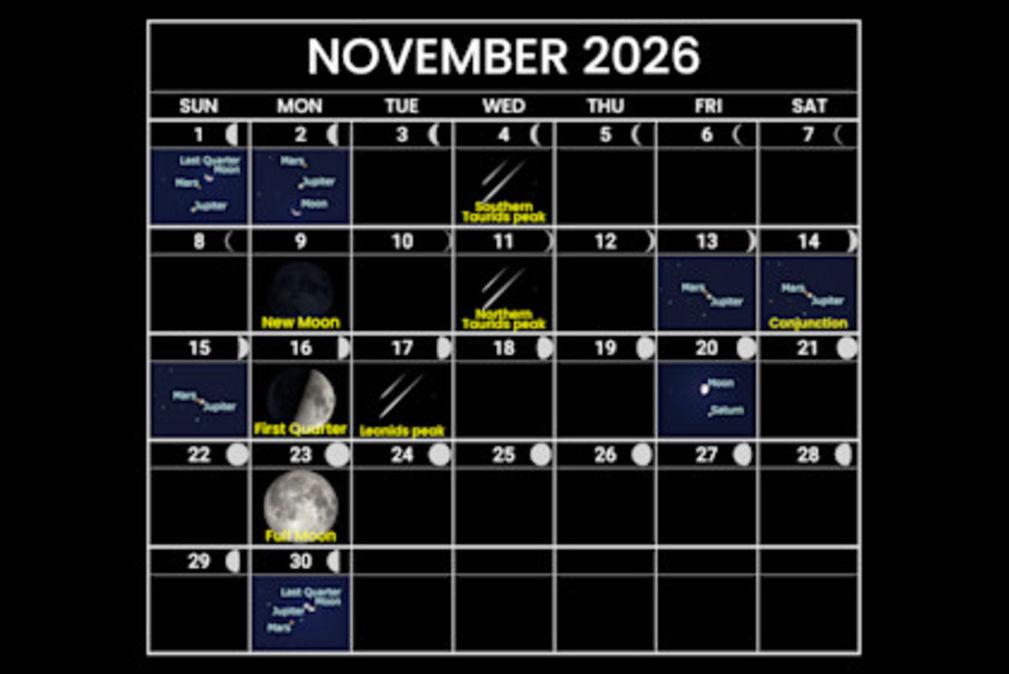
The Southern Taurids have an annual component peaking around October 14 and a fireball-heavy component peaking overnight on November 4 to 5, according to American Meteor Society dates cited by A Little Spark of Joy. SSBCrack reports that the Southern shower runs from September 20 through November 20.news.ssbcrack.com+1 2 sources for this line, starting with news.ssbcrack.com
The Orionids reached their peak around October 21 to 22, Space reports. The outlet says the shower takes its name from a point near the star Betelgeuse in the constellation Orion.space.com 1 source for this line, starting with Space.com
At the Southern Taurids' November 4 to 5 peak, the moon's disk is expected to be roughly one-fifth illuminated, Scientific American reports, according to A Little Spark of Joy. International Business Times puts the Northern Taurids' peak around November 11 to 12.ibtimes.sg+1 2 sources for this line, starting with ibtimes.sg
- ibtimes.sgThe Taurid meteor shower is active over Halloween in 2026(opens in a new tab)
- alittlesparkofjoy.comSouthern Taurid meteor shower builds toward two peak nights this fall(opens in a new tab)
- news.ssbcrack.comTaurid Meteor Showers Offer Unique Fireball Viewing Experience This Fall(opens in a new tab)
- space.comHow to see the Orionid meteor shower 2026 peak this week — and when to look(opens in a new tab)